
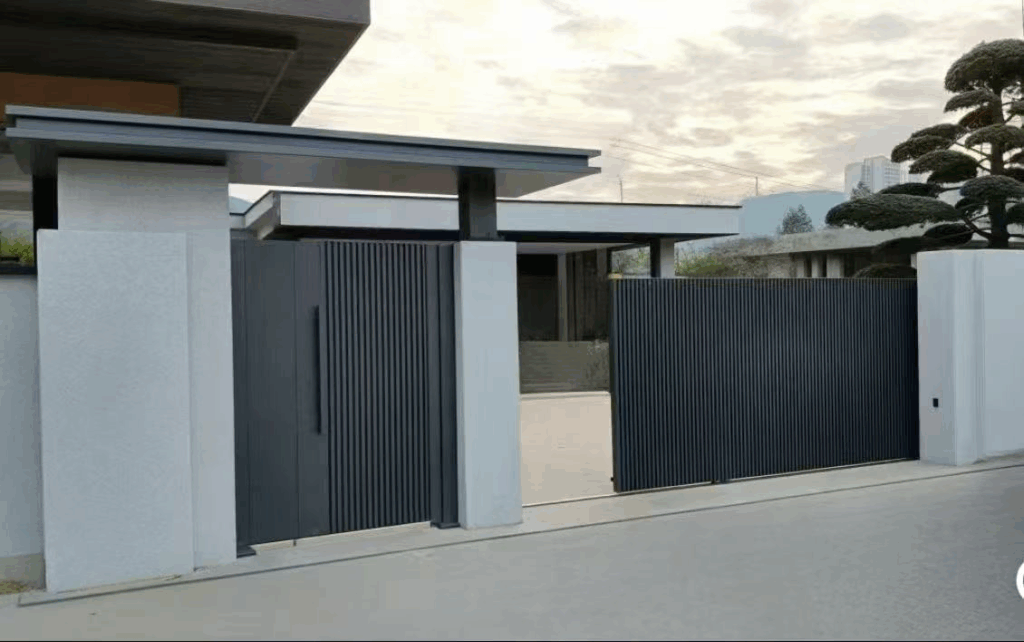
When planning a new aluminum alloy gate for your property, one of the biggest choices you’ll face is whether to go for a sliding gate or a swing gate. Both can be manufactured in premium powder-coated aluminum alloy for durability, style, and corrosion resistance, but their installation processes — and the conditions they require — are very different. Knowing these differences will help you make a confident, cost-effective decision.
1. Space Requirements and Layout
A sliding gate moves horizontally along a track or via a cantilever system, making it ideal for driveways with limited depth but enough space along one side. This design is perfect for properties with steep driveways or limited turning space, as the gate never swings into the vehicle path.
A swing gate, on the other hand, opens inward or outward like a traditional door. It’s elegant and often chosen for its classic look, but requires a large, clear area in the swing arc. For inward-opening gates, the driveway must be long enough to accommodate a fully open leaf without obstructing parked vehicles.
2. Ground Preparation and Structural Support
Sliding gates demand a straight, level base for the track or rollers, plus effective drainage to prevent water and debris from hindering movement. Installation often involves laying a reinforced concrete foundation for the track and motor.
Swing gates rely on strong hinge posts anchored deep into concrete footings. The posts must support both the weight of the gate and the force of wind loads. In uneven terrain, swing gates may need custom hinge alignment or stepped designs.


3. Automation and Operation
Both sliding and swing gates can be fully automated with electric gate motors, but the systems differ.
Sliding gate motors are mounted to one side, engaging with a rack-and-pinion drive along the gate’s base.
Swing gate motors are fixed at the hinge point and may be above-ground for easy access or underground for a cleaner appearance.
Modern automation can integrate with remote controls, smartphone apps, and security systems for ultimate convenience.
4. Security, Weather, and Maintenance
In windy or exposed locations, sliding gates often outperform swing gates because they have less surface area acting like a sail. Swing gates in these environments may need extra locking points or bracing.
For maintenance:
Sliding gates require periodic track cleaning and lubrication.
Swing gates need hinge inspections and motor arm checks to ensure smooth operation.


At JHR, we manufacture custom aluminum alloy sliding gates and swing gates designed for long-term performance. Every project is tailored to your site conditions and style preferences, combining high strength, modern aesthetics, and low maintenance. Whether you need the space-saving practicality of a sliding gate or the timeless charm of a swing gate, our expert team ensures a perfect installation from start to finish.